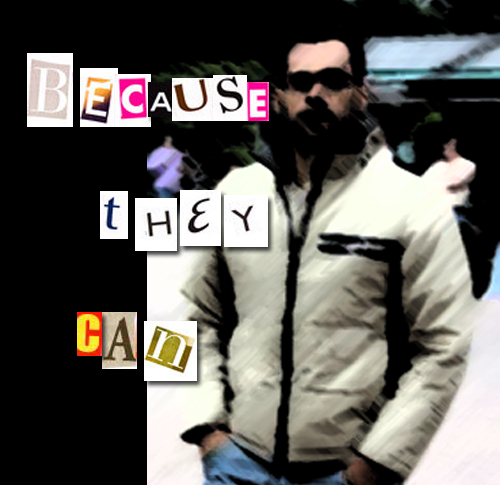
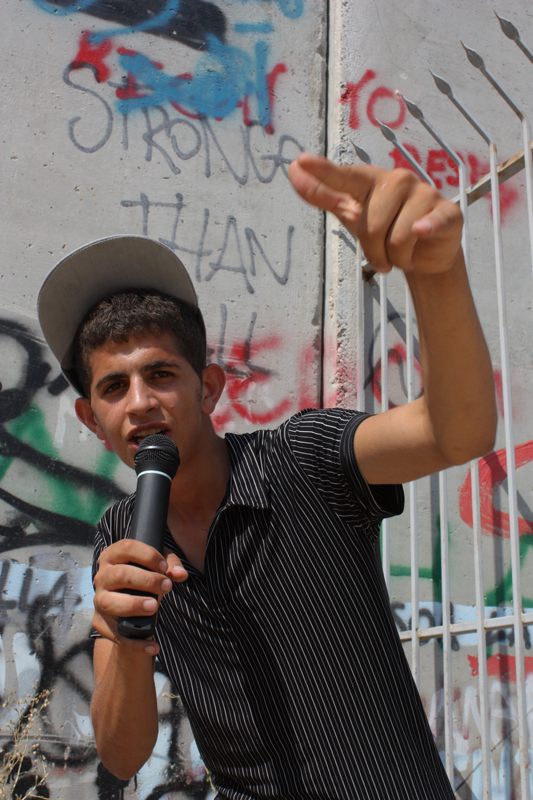
Photo: Sami Awad (left) of the Holy Land Trust with Radio Lajee’s Mohammad Qassim
Sami Awad is the Executive Director of the organization, Holy Land Trust. Recently he addressed a group of Internationals participating in the Lajee Center’s International Summer Work Camp about the bleak reality of life for Palestinians since the Oslo Peace Accords and the way forward through non-violent resistance.
Thanks to Radio Lajee’s Mohammad Qassim, this fascinating address is available for your ears too.
This is essential listening for anybody interested in learning more about the realities of life under Occupation, the truth about the so-called Oslo Peace Process and potential strategies for achieving a positive and peaceful outcome for the future.
Make a cuppa, sit back, listen and learn!
OK. I’ll say good afternoon to everyone and welcome to the Holy Land Trust. I guess the best way is to just jump into the topic and what I will talk about today is a little bit about our history and also about the non-violent activism that is happening in Palestine.
The initiation of Holy Land Trust as an organization, started during the time when there was a peace process. We had a peace process called the Oslo Peace Process – a process that happened years ago, it’s a part of our history now but people still talk about it. And the reason why I started the Holy Land Trust around that time is because I’d been living in the US, I was studying at college and I came back here in 1996 four years after the peace process began. And I came back like many Palestinians really excited that finally negotiations are happening and peace is going to be established between Palestinians and Israelis – the PLO was recognized as the legitimate representative of the Palestinian people and people were optimistic. And I would say on both sides when it comes to the population - and maybe not the leadership - on both sides people were optimistic that finally peace will be established in this part of the world.
But as soon as I came back I was shocked with the reality on the ground. There was no peace happening on the ground. Actually the opposite was happening. The situation for the average Palestinian became worse during the years of the peace process than what it was before the peace process began. Before the peace process we were living under direct military occupation where every aspect of our lives was controlled by the Israeli Military. We followed what were called Military Commands and Military Orders – there was no civil legal system to deal with the Palestinians. And that was very terrible and very bad and we were very much repressed under that regime and then we said, OK – a peace process. But then the situation became worse. So, how does a situation get worse when negotiating peace? Well, the reality was that Israel as the Government - and when I say Israel here, I mean the Government and Military I don’t specifically mean the people of Israel but the Government and Military did not have an intention to establish peace. It was an in intention to create a separation and control process. So we’ll give them the symbols of the State - never a State - and we’ll control everything that goes in and out of that State and what travels even between this State. So, this was the intention and now – if we look at the situation as it is now, it is very clear that what is happening now is just a continuation of that process.
In Oslo it was a negotiated process, now it’s not a negotiated process it’s an imposed process and the world of course remains silent. The situation for the average Palestinian became terrible and I’ll just give a few examples; the first aspect is the aspect of movement. Before the peace process began as Palestinians we could travel anywhere and everywhere. It wasn’t a big issue for a Palestinian to get in a Palestinian plated car - you saw the difference between a Palestinian plate and an Israeli plate? They have the yellow ones and we have the green and white ones. You could get in a Palestinian plated car and go to Tel Aviv and swim at the beach in Tel Aviv and come back the same day. This is when we were living under Occupation – when we were living under direct Military Control. To go to Jerusalem was never an issue. There were no checkpoints – absolutely no checkpoints like you see now between Bethlehem and Jerusalem. My mother’s family’s from Gaza. For us on a Sunday to get in our car at 10 o’clock in the morning and drive down to Gaza, have lunch at the beach, swim at the beach and drive back – that was almost a weekly activity that happened every weekend. So movement existed freely for Palestinians to travel everywhere before the Peace Process began. And of course, that meant that Israelis were able to come here as well. On a Saturday, the markets would be flooded with Israelis buying much better and much cheaper products from Palestinian markets and farmers than what they buy inside Israel. That was very normal. After the Peace Process began we started seeing restrictions on movement.
One of the things that started happening was an issue that we could have a whole lecture about called the ‘Permit’. As a Palestinian if you wanted to travel anywhere inside Israel – you wanted to go to Jerusalem or travel between Palestinian areas, you needed to have a permit. Of course when they gave the permits initially everybody got a permit. And the Palestinian leadership said, “Yes, – this is no problem what is the permit? It’s just another piece of paper that you carry with your ID card. So we all now had these permits – as I said, almost everybody got them - six months, 24 hours a day to travel wherever you want. Slowly we started seeing restrictions on the permit. Who got a permit /who did not get a permit. It went from six months to three months from three months to one month to a couple of weeks…From 24 hours to 12 hours to 10 hours some people got permits for 2 hours only. And the issue of the permit was linked now with what I call the ‘benefit factor’. How does it benefit Israel? Then Israel decides. If it benefits Israel to give Palestinians permits, they’ll get permits. So some Palestinians who worked in the labor force building inside Israel might get a permit. A Palestinian who was working in a Palestinian organization in Jerusalem? Well, it doesn’t really benefit us that much, so no permit to him. If you are a member of a political party that opposes the Peace Process and you know, if we claim to be a democracy where freedom of expression is allowed – then, there is opposition. Not all opposition is violent opposition.
And there were people that opposed the Peace Process because they saw that the situation was not improving for the Palestinians – well, you don’t get a permit anymore. We had something then called the ‘V IP Permit’. You know, then we had these Palestinians who were high ranking Palestinians from the (Palestinian) Authority from the leadership, members of parliament, high-ranking members of Fatah and other political factions they had a VIP Permit. A VIP Permit meant that you went through special checkpoints – you didn’t have to wait in line. Imagine, on a very hot day like this a group of 500 Palestinians, all of them having permits, standing at a checkpoint being controlled by two young soldiers who are telling them with a finger who can go and who cannot go, for hours. And then you have this black, Mercedes, air conditioned, shining…Drives up to that same checkpoint and the Palestinian leader only has to roll down his window this much so it doesn’t get too hot inside his air-conditioned car and just has to waive this permit and show his face and the soldier says, “go ahead.”
Now these 500 people if they were mad and upset at the soldiers, guess now who they are mad and upset at? Our VIP person. And this is part of this ‘divide and conquer’ mentality that the Israeli Government was playing and continues to play until this day. So, restrictions on movement…And there’s lots of research that has been done just on the number of hours - labor hours that are lost every single year, by Palestinians who are not able to go to their jobs on time even within Palestinian areas because of the restriction on movement.
What’s interesting to note about these restrictions on movement is that it’s always linked to a security issue, security issue, terrorism, security issue. All of these restrictions were applied before there were these mass suicide attacks that were taking place by Palestinian factions inside Israel. This is part of the agenda that was leading up in the Peace Process itself. I always have to make this point clear because you will hear the argument, “oh, it’s for security reasons that we have to do these things.” This is a falsehood. Permits were granted before this whole issue and restrictions before this whole issue. Now the restrictions were not just on the movement of people, it was also on the movement of products between the Palestinian areas. And I’ll just give one example of this, between Gaza and the West Bank. Gaza has always been a major source of vegetables for the West Bank, especially potatoes and tomatoes. And this was very normal again for these truckloads – caravan loads of these products to come into the West Bank and be sold here. After the Peace Process began we started seeing restrictions on this movement, on these products. And even if they had permits, the Israeli checkpoint at Ares - the one north of Gaza – they would stop these caravans carrying these products - not for hours, not for days, but for weeks. Until the product gets rotten and then they would say, “Ok, now you can go.” Now, you look at this and you might say, evil, bad…and so on. But it’s not about an issue of “evilness” or not, it’s once again about this benefit factor. And this one’s easily calculated – you could guess. The benefit factor is by not allowing Palestinian produce and products to be transported between the Palestinian areas they are able to flood the Palestinian markets with their products.
So, we were getting Israeli potatoes, Israeli tomatoes and Israeli dairy products. We became - after the Oslo Peace Process began - we became the second biggest market for Israeli products after all of Europe. And this is the small Palestinian community: 5 million people in total that live here, Israel created a situation where economically it was benefiting from this restructuring and reshaping of the Occupation and the Palestinian farmer suffered during that time. There’s many, many examples I could give but I just want to give one final example as to why Oslo failed and why as an organization it was something that initiated our launch; and this is the issue of the settlements. As you know, settlements are illegal, they are considered illegal under international law, the United Nations resolution…Every single country in the world including the US and Great Britain and any country that you have come from, have deemed the settlement policy as an illegal policy or, if we go to the US language, an “obstacle to peace”. You know, this is the harshest language that the Americans can use. But still, it is still a statement.
It was very clear again that the Israeli Governments and really it did not matter whether Left or Right – had an agenda of confiscating as much land as possible, building as many settlements as possible and moving as many settlers illegally as possible into the West Bank, during the years of the Peace Process to create what are called ‘facts on the ground’. Which means it would make it difficult if not impossible to negotiate this mountain top, this area, this valley in the future. And of course, the biggest example we have in Bethlehem is the settlement of Har Hamar, which is built on Jebel Abu Helaim which used to be the last remaining forest in the Bethlehem area - we used to go there for BBQ’s and camping and before the Oslo Peace Process the Israeli Military had an order not allowing a Palestinian to uproot a single tree from this forest. It was probably the only Military Order that was environmentally sound – because it was a ‘green territory’ they claimed. And of course, now we know why they wanted it to be a green territory because they did not want Palestinians not to uproot trees but, not to build anything because they wanted this mountain. That was again part of the agenda that they had years and years before they did this confiscation.
In 1997, four years after the Peace Process began, bulldozers came destroyed all the trees and now you see this ugly settlement. In a couple of years more than fifty thousand people will live in this settlement and let’s say it reaches negotiations. Let’s say the US comes and says, “Israel, you know this is still Occupied Territories you have to negotiate this settlement Har Hamar.” What is Israel going to do? They’re going to say, “Look, Palestinians, we understand this is the Occupied Territories – we should not be here. But, we have fifty thousand people living here now and if we create any conflict with these fifty thousand people we’re going to have riots inside Israel and we’re going to have civil war inside Israel and then we’ll never have peace with you. So you might as well just forget about this. Let’s negotiate something else.” And the Palestinians sadly are going to say OK. They’re going to surrender this mountain in order to get something else - maybe more symbols. But this is the reality – creating facts on the ground that would make it difficult or, like I said, impossible to negotiate these areas. And this is just one of tens and tens of examples that exist all around the West Bank. How can you be negotiating a two-state solution when the two-state solution is founded on a simple premise of two-states - a simple premise of finding any state his land. And the Palestinians lost more land during the years of Oslo than in all of the years of the Military Occupation. The number of settlers was 200,000 settlers in 1993, in 1999 the number was 425,000 settlers – more than double – again during negotiations – during the peace process. Now the number has gone over 520,000 settlers. Now of course the concentration of this whole settlement movement is in and around Jerusalem. Creating facts on the ground inside Jerusalem itself that will make it again difficult, if not impossible to negotiate these areas. So, this was one of the things that for us as an organization we said as a group of people yes, we have to do something about this.
Yes, we want peace and we want to establish peace, but this was not the way. It was very clear. And I’m not saying that we had a revelation with this – many people had written and talked about this. I always recommend to read Edward Said, if you haven’t yet - a great Palestinian author who from the beginning of Oslo was very clear that this was what it was all about. So, if you have a chance, get any of the writings of Edward Said and read them - as well as the Israeli authors that have written about these issues as well.
So in 1998, Holy land Trust was established as an organization. Our mission, our goal is to strengthen the community for the future. What does that mean? Strengthening the community for the future for us means that as Palestinians, we have to take responsibility. If Palestinians do not take responsibility and deal with the challenges directly nobody will. No one is going to come and liberate us from outside. The Israeli policy, the Israeli Government, the Israeli Military are not interested in any peace. I would actually say part of the Zionist mentality, is not to be interested in peace as well. For Zionism to survive you need to have enemies. And, if you don’t have enemies from outside then you have to deal with all the issues that exist within Israel itself – and that is a big challenge because Israeli society is not a unified society. Now they are unified by having an outside enemy. But the moment that outside enemy disappears or there is peace with that enemy, then all of these internal issues will arise within Israeli society itself. And again, there are many Israeli authors who have written books about how as soon as peace is established with the Palestinians; Israel will be divided into four states within Israel itself. If you talk about the conservatives, you talk about the Orthodox, you talk about the reformists, you talk about the Arab/Palestinian community inside Israel - it’s a big mess. And as I said the unifying factor is having this outside enemy and they’ll have this enemy for as long as it takes.
So, for us it is about us taking responsibility. So what we do as an organization is we look at the challenges. Ok. What are the challenges that face the Palestinian community? And how can we as an organization provide tools and services to address these and to deal with what I would say is the biggest enemy that we can have as Palestinians which is the enemy from within. When we become the worst enemy. And the worst enemy is the enemy of victimization - when you trap yourself in victimization, you trap yourself in pity and you trap yourself in isolation - “nobody cares about us” and, “there’s no hope for us”, and this feeling of resignation that’s exactly what the Occupation wants. And the sad reality is that Palestinians have again – for many reasons – fallen into this trap as well. So for us, it is about strengthening this community but not just for today but for the future as well. What is the vision that we can create for the future of Palestine led by the Palestinians? Of course the first challenge and the biggest one is the Occupation. As I said the Occupation has not ended it has only been reshaped and reformed to best benefit Israel. And we can see this; economically, politically – everything that is happening now solely falls into benefiting Israel. So how can we as a Palestinian community remain resilient, steadfast and resisting of the Occupation? This is the number one challenge.
A second challenge which is very important for our organization - and this is a question that not many people ask but we feel is very important and it’s the question of what comes after the Occupation ends? You know, you hear the big campaigns; end the occupation! /end the occupation!/ free Palestine!/ end the occupation of Palestine… And then what? What will Palestine be? What guarantees do we have as a people that the future of Palestine will be the future country that we dream of, that we have been fighting for – that martyrs lost their lives for? That over 12,000 prisoners now exist because of fighting for this freedom? There’s absolutely no guarantee – and if we look at examples from all over the world – there’s absolutely no guarantee that by ending a colonial rule or occupation of a country that this country immediately flourishes into democracy and respect for human rights and pluralism, gender equality, rights of minorities, freedom of expression…Actually if we take it as a global issue we have seen the contrary. Most countries after they have been liberated from a colonial system will fall into civil war, will fall into military rule, will fall into one party rule or police states and dictatorships - you name it. We just have to look at the region itself. We don’t have to go far. You look at Jordan, you look at Syria, you look at Iraq, you look at Egypt - you name them – I mean, they are all around us, so what makes us different? Unless we’re able to prepare ourselves as Palestinians by planting these seeds even during the time of Occupation, we will not be able to get these things once the Occupation ends.
To address these two challenges as an organization we are committed to non-violence. We believe that non-violence is the only way forward for the Palestinian community. And when I talk about non-violence – there are many definitions of non-violence. Some people when they hear the term “non-violence” think that this is about being passive, this is about being nice to the other side, this is about sitting around the campfire singing Kumbiyah all night long and sharing feelings…And I’m not opposing Kumbiyah – my daughters love it when I sing it to them. But at the same time we also talk about non-violence as resistance. It is about standing up and being ready to sacrifice everything including one’s life in an act where no arms are being used, no violence is being reflected on the Occupier and when we say “no-violence” we mean it in the physical, mental and spiritual sense as well. So it’s not about, yes I’m not going to shoot at the soldier but I’m going to beep beep beep beep his mother and his grandmother every time I see him because for us we believe this is a form of violence as well. And we believe non-violence is very important not just from this moral perspective, but also from a strategic understanding of what is happening in Palestine. We believe that non-violence again is the only option. Because if you look at it strategically, when you engage in warfare, when you engage in a liberation movement you have to create a real assessment - an assessment of what is your strength and what is their strength? What are your weaknesses what are their weaknesses? And you never go and wrestle a Sumo fighter if you know he’s much better than you. You know, if you’ve been challenged by Sumo wrestler you’ll try and take him to play a game of chess or whatever you’re better at. Not jump into the Sumo ring with him.
We understand that Israel is a very strong military power it is the fourth largest power per capita not including all their nuclear arsenal and so on, very well trained in military warfare. We’ve never had a single military institute that trains soldiers in Palestine. So our strength is in our people. Our strength is in our unity. Our strength is in our resiliency and our steadfastness. It is not in engaging in armed resistance and I would say this again strategically – where we stand now. Maybe 50 years from now the situation will be different. But now, we don’t have the military capacity to resist the Israeli army in that way. But, we have the strength of public opinion of global opinion and our ability to engage in non-violence – we have a history of this. So when we talk about non-violence we’re not talking about bringing theories of non-violence and we’re not talking also necessarily about doing what Gandhi did or doing what Martin Luther King did. We have in Palestine a very rich culture and history of engaging in non-violence as well and the greatest example is not too far back – the first uprising, the first Intifada in 1987; when Palestinians did unify did engage in mass activities, mass protests, mass strikes, demonstrations, civil disobedience, refusing to pay taxes to the Israeli Military, homeschooling – when they shut all our schools. The First Intifada is really an example that is now actually being taught at universities all around the world as to the power of engaging in non-violence. If you ask me to put a word next to non-violence I will always use the word “empowerment”. What non-violence does is fully empower a community to say, “Enough is enough. We will not remain silent anymore.” Now, when you engage in armed resistance – armed activities, even if it’s legitimized, usually as you could guess, a select group of people would engage in armed resistance and activities. Usually it is younger men who would engage in this of course we have had women engage in this but the average person who engages in armed resistance are young men who are armed and ready to engage in this fighting. The rest of the population is completely isolated or marginalized from the resistance. In the First Uprising everybody participated. If you were a 5 year old child or a 95 year old grandmother – you were out participating you were out doing something. You were out taking care of people who had been beaten up. If a young man was being arrested in Aida Refugee Camp for example, you would have 10 women jumping up and down claiming that he is their child that they all are his mother. And the soldiers would freak out and leave that person alone.
So when we talk about non-violence as a strategy, it’s not about just doing demonstrations – yes, now we are engaging in many demonstrations, but it is about resistance and mostly through non-compliance and non co-operation. We live under military orders. We live under thousands and thousands of military orders and when you begin to tap this issue of the military orders and you say I refuse to obey this single military order and I will unify my community and enroll my community in refusing to obey even a single military order this creates such a shake-up in the military establishment itself. And I’ll just give one example from the First Uprising; you know how you change your time from daylight savings time to winter time? When we were living under direct military occupation and direct Israeli Authority, our media was controlled by Israel – essentially we didn’t have media, let me say this. We had a few newspapers that were all censored by Israel. And we used to follow Israeli media – Israeli television, Israeli radio, Israeli news – this is what we had. So when the announcer comes on TV and says the Government has announced that tomorrow we will change our clocks and move them one hour forward for daylight savings time, so everyone would sleep at night and then the next morning when we woke up we would all work with this new time. What we had in this First Uprising was a unified underground command who were very creative with different things and would give us in a sense orders that we would follow. One day we got this leaflet that was spread all around Palestine and the leaflet said, let us try something; let us not change our time until a week after Israel changes its time. Let us create something called ‘Palestine time’ for one week. Now where is the threat to Israel in this? Nothing. It doesn’t threaten a single Israeli when Palestinians change their time a week later. So all of us would sleep and we would wake up and not change our time and we would spend a whole week living in a space and time called ‘Palestine Time’. We used to be children in school we probably had these big ugly watches with Mickey Mouse on them or something and we would live under ‘Palestine Time’ for a week with a feeling of pride and identity. We would go to school on Palestine Time. The teaches would come early and they would not find any students so they would come for a day or two and then they would have to change to Palestine time. When my father would go to work, I’d say “what time are you going”” and he’d say, “Sorry son I’ll wait another hour.” Yeah, Palestine Tim we’d go to work. Offices would run on Palestine time, services would run on Palestine time. Again – absolutely non-threatening but so empowering for Palestinians that empowerment itself was a threat. Israeli soldiers at that time were only ordered to do one thing. You could be carrying a box of Palestinian flags which was completely illegal and you’d spend time in prison if you had these flags and yet the soldiers were ordered only to see your watch and what time you had. And they would stop you in the streets just to see what time you had and if you were not on the new time – on the Israeli time they would demand you to change the time. Now of course most Palestinians would say “Ok I’ll just change it in front of him, walk a couple of meters away and I’ll change it back. But there were some Palestinians who were so strong and so committed that they refused. And these Palestinians were either arrested or two soldiers would hold the arm of the Palestinian and begin beating him and beating him until they had broken the wrists and the watch of the Palestinian. Tens and tens of examples of that - how threatening a single act of non-compliance was to an entire structure of occupation.
Not a single bullet had to be shot to shake Israeli Military Occupation. This is the power of non-violence that we are talking about. This is the kind of creativity that we are seeking also within the Palestinian community. Of course in 1999 as you know the peace process failed. There were last attempts in the year 2000 to put something together…As I said there was absolutely no intention and now finally to see so many Israeli authors and writers now talk about the hidden agenda of the Israeli political establishment during the Oslo Peace Process that was really not interested in peace. It was again just interested in the restructuring of the Occupation itself. So the year 2000 happened, things collapsed and we fell into the Second Uprising – the Second Intifada. Which as you know has been one that has been very violent. Many people have been killed. And I never like to give statistics because in full honesty you can not go to a Palestinian mother and comfort her by saying “more of us have died than them,” or an Israeli mother and say, “less of us have died than them”…When a son dies, both mothers are crying the same tears. So it’s not about numbers, it’s not about statistics – both sides have suffered from what we continue to experience. And again the sad reality is that the political establishment in Israel has continued in its policy of not allowing for real peace to be established.
As an organization, we were challenged initially after the First Uprising because there was this feeling by many Palestinians that we had tried non-violence and it led us to the Peace Process and look at where that got us. So they linked non-violence with the peace process. So for us we created this as two distinctions; To engage in non-violence is one thing and dialogue is another thing. So we succeeded in non-violence and failed in dialogue. We failed in negotiations. But for people at that time they said no, we have to try different strategies. So this is when you saw some of the militant groups saying, we have to engage in armed resistance, we have to make the Israelis see the pain and the only way they can see it is to suffer. So that was a strategy that was adopted by some of the militant groups. Of course, one of things that was very apparent is that the Israeli Military establishment was not interested in seeing Palestinians engage in non-violence. I’m not saying they wanted to see us engage in armed resistance or violence, but it was very clear Protests engaging in such activities that were non-violent - the Israeli Military suppressed these activities very quickly and very violently. Again there’s been a lot of research done on the number of martyrs killed in the first months of the Second Uprising – compared to the first one. We did some simple research on the number of children in the first 2 months of the Second Uprising – this is October and November of the year 2000; 60 Palestinian children under 16 years old were killed and shot by Israeli Military bullets. This doesn’t include settlers, this doesn’t include any deaths other than those resulting from the Israeli Military. If we compare this number of fatalities to the First Uprising it was almost 3 years before we reached that number. An Israeli documentary came out called ‘One Million Bullets’ – the number of bullets shot by the Israeli Military in the first week of the Second Uprising – one million bullets. So there was this immediate attempt by the Israeli Military to suppress non-violence which led to the killing of many Palestinians and of course as soon as Palestinians are dying on the streets in mass numbers like what was happening - you throw strategy out the window. It becomes about revenge and retaliation about that close relative of mine who has been killed – I’m going to have revenge and retaliate for this death and this is the cycle of violence that we experienced.
In the year 2002, The Arab League – Arab countries initiated a peace initiative called ‘The Arab League Peace Initiative’ and this was another great opportunity for Israel – again, if Israel was interested in peace. And the Arab League Initiative was that we are ready – all Arab countries (including Saddam Hussein at that time) to recognize the full right of Israel to exist as a country and we are ready to build complete diplomatic relations with Israel if they are prepared to withdraw from the Occupied Palestinian Territories and allow a Palestinian State to be established. Israel said, “no.” And in fact, in response, Israel did not just say no. Israel engaged in an all-out attack on the Palestinian areas. You may have heard about the massacre that took place in Jenin Refugee Camp in 2002 – the same thing happened in the old city of Nablus. The President’s compound in Rammallah – Yasser Arafat was put under arrest – Compound Arrest - in 2002. In Bethlehem, we had the siege of The Church of Nativity - 40 days and 40 nights again during that time. So even in the twilight of violence, alongside this initiative, Israel said “no.”
It was also a wake-up call fro many Palestinians especially for some of the Military groups who began to realize that engaging in armed resistance - again from a strategic point of view - was not achieving the results that we wanted and this is when we started seeing a growing interest in non-violence. We started seeing villages begin to resist through non-violence especially in areas where Settlements are being expanded or this illegal Separation Apartheid Wall is being built. Now I would say that non-violence is not a movement – so I don’t want to create a falsehood and say that there is a Palestinian non-violent movement taking place. But I would say that now we are seeing within the Palestinian community – I want to say an almost full acceptance of non-violence. So people understand it theoretically, it just hasn’t gone into practice and hasn’t gone into building a proper strategy for Palestine. This is something that many of us are working on - many organizations. Where non-violence is mostly present now is in several things like direct action; for example, resisting The Wall and resisting Settlements. In the Bethlehem area alone, there are several places where there are weekly actions taking place. Palestinians, Internationals and Israelis come together to stand together in non-violence to resist the building of The Wall and Settlements. I think Bethlehem now has what we call six “hot-spots” in these areas. This means that it’s not just about one action every so often, but a continuation of action taking place in these areas.
The other side of this campaign is the global non-violent movement taking place that was initiated by Palestinians which is the campaign called ‘BDS’ – Boycott Divestment and Sanctions. Part of what we’re seeing now which is mobilized at a global level and is steadily growing is this idea of calling for boycott, divestment and sanctions towards Israel. Most of the campaign now has revolved around Settlements and products that have been produced inside these Settlements – which again are considered illegal under International Law and we’re seeing governments around the world begin to engage in this discussion about Settlement products. And in the private sector, there are a many groups many individuals who are choosing to engage in this campaign as well. Many people become sensitive when they hear people talking about BDS but I am always very encouraged when I hear Israeli activists talking about BDS as well. Activists who say, “this is exactly what we need. We need people from around the world to wake us up, and the way to wake us up is by engaging in these campaigns where people from around the world tell us - you don’t have full legitimacy anymore to do whatever you want.” BDS does not threaten the existence of Israel – this is something very important for you to know and for you to share with others. BDS does not threaten the existence of Israel, it creates an opportunity for Israel to realize that they have to change their policies in order to become a normal country like everyone else.
As an organization, we don’t have a set political agenda – we feel it’s not our responsibility as an organization to say what the best political solution may be. For us what we try to do is address the issues that are not allowing for a political solution to take place. So you hear people talking about the One State Solution, you hear people talking about the Two State Solution; I had a scholar from Germany or Holland once, try to convince me that the Seven State Solution is the best solution. So you have different political scenarios, but it’s not about attaching yourself to a political scenario and saying, this is the best one. Because as we see now the Two State Solution is not a workable solution, and I would even say that even if Israel pulled out from the West Bank, East Jerusalem and Gaza tomorrow, it does not mean that there will be peace. It does not guarantee not only a Palestinian state but also peace between the Palestinians and Israel. So it’s not just about ending the Occupation - it’s about addressing the issues. Always trying to discern the issues that prevent what I would say is a core value that is big-time missing here; the recognition of equality. You know, Israel – even if Israel pulls out of the West Bank tomorrow, if Israel doesn’t recognize the rights of Palestinians to be here on this land, to have equal opportunity, to have equal possibilities created for them, to have equal education, equal pay, equal freedom to move and travel, what’s the point? So yes, they might pull out of the West Bank and create a big prison like they did in Gaza. Or they restrict all our movement – waiting for something else to happen in order to expel us, or something like that. And again when we look at the One State Solution – we don’t see a real solution when Israel is based on a premise where the majority of the population has to be Jewish. So we need to address this issue of why does it have to be a country where the greater majority has to be Jewish? Which means that we have to deal and address the fears that exist within the Jewish community of feeling like they are not accepted around the world. Now this is not just a Palestinian responsibility - this is a job for all of us. If you’re from Germany, what have you really done to engage in a real healing process with the Jewish community? Pumping in billions of dollars every year and giving them surplus political mandate to do whatever they want, has not done anything but create a further sense of isolation for the Jewish community. So the global community has not done anything yet I would say to challenge this issue of finalizing the Holocaust and closing this file completely. And I say this full of respect and full of knowledge of what happened in the Holocaust because I’ve been to Auschwitz and I’ve read the books, I’ve seen the tragedies and I would say again, that no healing process has taken place. And unless a real healing process takes place where there’s not just apology but there is forgiveness, then nothing will happen. And we will remain with the idea that we’ve convinced ourselves about - that the Jews have the right to establish a homeland for the Jewish people alone. This for me is the worst form of racism when we allow this to happen. We are allowing the Israeli society to be a racist society towards the Palestinians – as an international community. So this is what we discuss here as an organization these are the challenges that we look at. And we keep digging deeper and deeper until we reach something that is a core issue that has to be addressed - and then working at getting Palestinians to address it, getting Internationals to address these core issues becomes the challenge for us.
Thank you.
Tags: Activism, BDS, Boycott Divestment and Sanctions, First Intifada, First Uprising, Gaza, Holy Land Trust, Human Rights, Israel, Lajee Center, non-violent resistance, Oslo Peace Accords, Oslo Peace Process, Palestine, palestinian, Palestinian resistance, Radio Lajee, Resistance, Sami Awad, Second Intifada, Second Uprising, Settlements, West Bank
Posted in Uncategorized | 3 Comments »